
Flexible cladding option
Seven problems a flexible cladding option solves
Flexibility is not a feature you specify for its own sake. It is the answer to a specific set of problems that rigid cladding creates — here they are.
Every rigid cladding material — stone, ceramic, porcelain, fibre cement — shares the same constraint. It arrives as a flat plane and can only ever be a flat plane. Everything that is not flat has to be approximated by cutting the plane into smaller pieces and accepting a joint everywhere the geometry changes.
For most of building history that was simply what cladding was, and the detailing grew up around it: mitres, return pieces, quadrants, shadow gaps. Those details exist to hide the fact that the material could not follow the building.
A flexible cladding removes the constraint rather than detailing around it. What follows is the list of situations where that actually pays for itself.
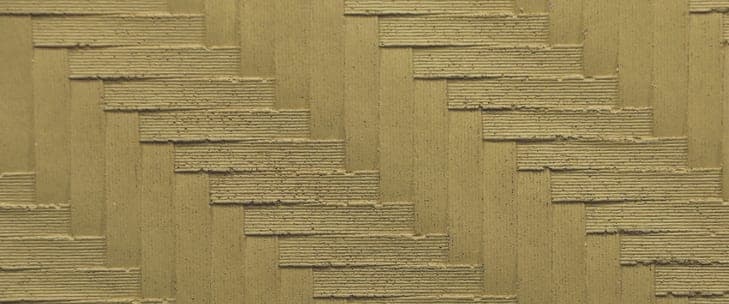
Deep relief like this is exactly what a rigid material cannot carry around a corner without a visible cut.
The seven
When flexible is the right call.
If none of these describe your project, a rigid cladding is probably the better and cheaper answer. We would rather tell you that than sell you the wrong thing.
The wall is not flat
A column, an arch, a curved reception front, a barrel-vaulted soffit. A rigid sheet has to be faceted or cut to shape, and the mitres are visible from every angle. A flexible sheet wraps it, and the texture runs continuously through the curve.
How curved cladding is set outThe structure cannot take the load
A refurbishment where the frame was designed for render. Checking and strengthening it to carry a 55 kg/m² stone rainscreen is usually what kills the scheme at cost stage. At 4.5 kg/m² the question never gets asked.
Weight and load figuresThere is no room for build-up
The cladding has to land flush with an adjacent finish, or inside a joinery reveal, or on a partition that cannot grow a nib. Thirty millimetres of stone plus adhesive bed does not fit. Three millimetres does.
The site bans wet cutting
Most mall fit-outs and every occupied-building refurbishment prohibit slurry and diamond blades. Flexible sheets cut with a knife, dry, with no water feed and nothing to clean up afterwards.
The dry application methodThe finish has to carry into a wet area
A bedroom wall that continues into the ensuite, a spa treatment room, a covered balcony. Waterproof and fungus and algae resistant means one material through the door instead of a change of finish at the threshold.
The programme is measured in days
Retail fit-outs and hotel refurbishments that hand over on a fixed date. Adhesive and a notched trowel covers ground several times faster than stone, needs no specialist trade, and has no curing period holding up the next contractor.
It has to be repeatable
A rollout where the store in Chennai must match the store in Bengaluru, this year and next. A working quarry cannot promise that; a manufactured mineral body with a shade code can.
Shade codes across 23 collections
Being straight about it
Where flexible cladding is the wrong answer.
Three cases where we would point you elsewhere.
You need genuine stone. If the value of the wall is that it is quarried marble, no manufactured mineral body substitutes for it, however convincing the face. Specify a real stone veneer and detail the corners properly.
The substrate is bad and staying bad. A bonded 3mm sheet follows the wall underneath it. Undulation, hollow render and damp all show through — and deep-relief collections show them most. A rainscreen on a frame can span over a poor substrate; this cannot. Substrate preparation is not optional here.
You need a ventilated cavity. If the facade build-up depends on air moving behind the cladding — for thermal performance or to manage moisture in the wall — a bonded finish is the wrong system entirely. That is a terracotta rainscreen job.
FAQ
Questions about flexible cladding
How tight a curve will it bend around?
The limit is quoted as a diameter: the tightest circle the sheet forms cold is 381mm — 15 inches — across, which is a 190mm radius. In practice that means it wraps any circular column of 381mm diameter or more, plus arches, barrel vaults, coves and curved reception fronts, with no heat, scoring or relief cuts. Vertically corrugated collections such as Ripple Stone and Liner Stone handle the tightest end best, because the corrugation absorbs the compression on the inner face. Below 381mm diameter, and on a sharp external arris, the bend is outside what the material will do — those need a radiused substrate or a conventional mitre.
Is it fire rated?
Yes — Level A1, the highest non-combustible classification. That is what makes it usable on high-rise elevations, escape routes and protected stair cores where combustible cladding is not permitted.
Can it be used outdoors in the Indian climate?
Yes. It is waterproof, UV stable so a south or west elevation holds its colour, and fungus and algae resistant, which matters on a north wall through the monsoon. It is also freeze-thaw resistant, so it is suitable for hill-station projects.
How is it fixed?
With a notched trowel and a polymer-modified adhesive applied to the substrate. The sheet is pressed on, worked out from the centre to expel air, and rolled. There is no mechanical fixing, no support frame and no wet cutting — sheets are trimmed with a knife or shears.
Can the colour be changed later?
Yes. The surface accepts mineral paint, so a wall can be recoloured without stripping the cladding off — useful for retail rollouts and hospitality refurbishments where the texture is worth keeping but the palette changes.
Is it suitable for bathrooms and wet areas?
Yes. It is waterproof and fungus and algae resistant, so it carries straight through from a bedroom into an ensuite without a change of material at the door. This continuity is one of the most common reasons it gets specified on hotel and spa projects.
Get a quote
Tell us about the wall.
Describe the problem rather than the product. If a flexible cladding is not the right answer we will say so.
Request a quote
Send us the area, the substrate and the finish you have in mind. We reply with shade options, a written price and a lead time — usually the same working day.
The enquiry form loads in a moment. If it does not, email us at enquiry@curvato.in and we will pick it up from there.
Get a quote
Send us the wall. We'll send back a quote.
Tell us the area, the substrate and the finish you have in mind. We reply with shade options, a written price and a lead time — usually the same working day.
- Thickness
- 2.5–3.5 mm
- Weight
- ~4.5 kg/m²
- Fire rating
- Level A1
- Min. bend dia.
- 381 mm (15 in)