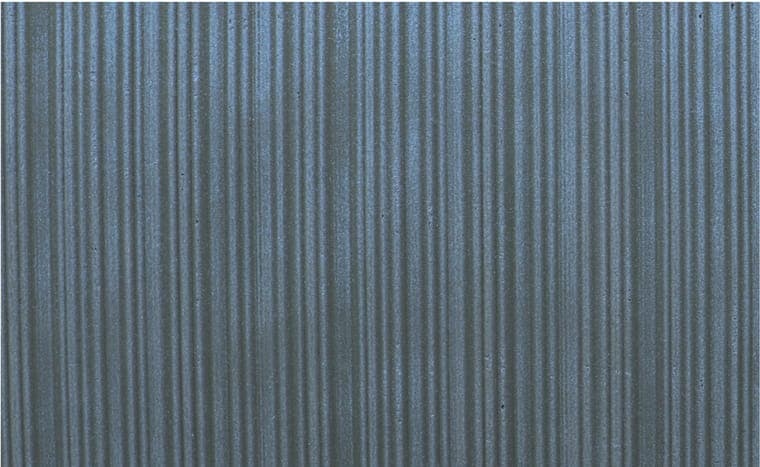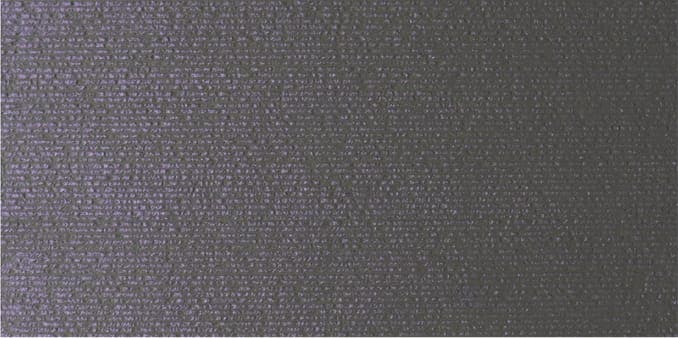
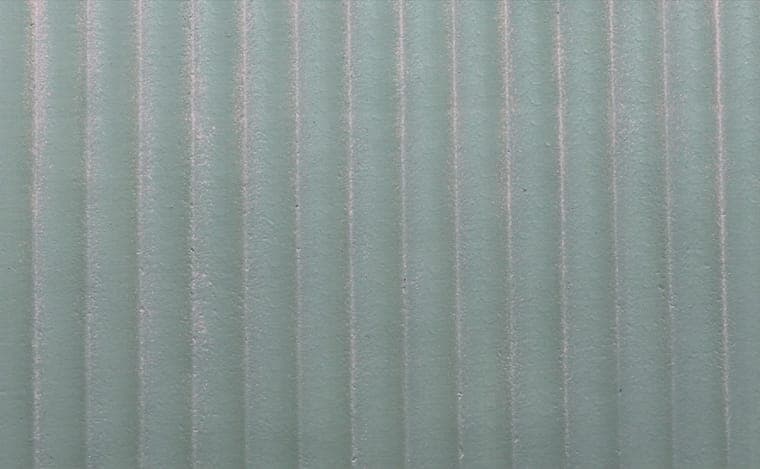
Ripple Stone
6 shadesSoft vertical corrugation, six tones
Curved cladding option
A rigid cladding meets a curve and has to be cut into it. A flexible one follows it, down to a 381mm (15in) diameter column. This is what that means for set-out, seams and cost.
A circular column is a developable surface — you can wrap a flat sheet around it without stretching or tearing. Stone cannot take advantage of that, because stone will not bend. So a stone-clad column is built one of two ways.
Bespoke curved sections, each one cut on a CNC to the exact radius, delivered in a numbered sequence and hoisted into place. Accurate, beautiful, and priced accordingly — and a four-week lead time before anything reaches site.
Or faceting: approximating the circle with flat segments and a mitre at every join. Cheaper, and it reads as a polygon pretending to be a cylinder. The mitres catch the light and you can count them from across the lobby.
A flexible sheet takes the third route, which is simply to wrap the column. The texture runs continuously around the radius. There is one seam, on the back, where nobody stands.
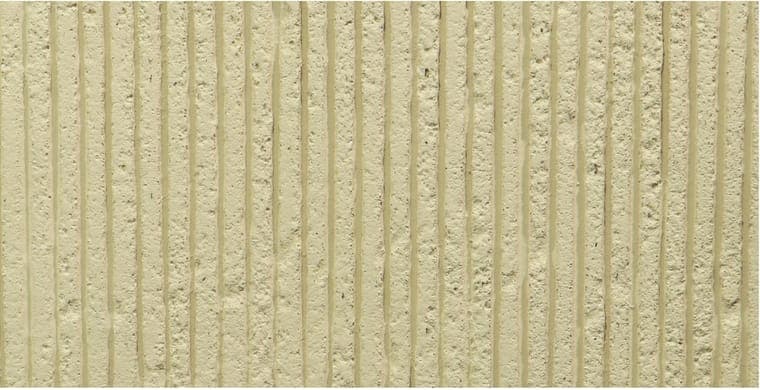
Cut Stone · CS-1
Every texture here wraps a column down to 381mm (15in) in diameter. No bespoke curved sections, no CNC, no visible cut on the face.
Radius guide
Cold, without heating, scoring or relief cuts. The limit is quoted as a diameter — the tightest circle the sheet will form is 381mm (15in) across, which is a 190mm radius.
| Circular column, 381 mm (15 in) dia. | The minimumThe tightest circle the sheet forms cold — a 190mm radius. Achievable, but sample it on the actual radius before committing a whole job to it. |
|---|---|
| Circular column, 450–900 mm dia. | StraightforwardThe most common case, and comfortably inside the limit. Two or three sheets per course with the seams set out to fall away from the primary sightline. |
| Curved wall, radius over 1 m | StraightforwardThe sheet barely notices the curve. Set out as if it were flat. |
| Arch soffit and reveal | StraightforwardThe soffit and the reveal are clad in one continuous piece, so there is no joint at the springing. |
| Barrel vault, cove, curved ceiling | StraightforwardAlmost always a large radius. The sheet runs from wall into ceiling without a break at the junction. |
| Circular column under 381 mm dia. | Not achievable coldBelow the minimum bend. Either increase the column diameter, or detail it as a faceted rigid cladding instead. |
| External corner, 90° sharp arris | Needs a radiusA sharp arris is far tighter than the material bends. Give the corner a radius of at least 190mm, or detail it with a conventional mitre or return. |
On site
Four decisions that separate a column that looks machine-made from one that looks wrapped.
Every wrap has one vertical seam. Find the primary sightline — the direction people approach from — and set the seam out at roughly 135° from it, so it sits on the far quarter of the column. On a column in open circulation with no primary approach, align the seams on all columns to the same compass direction; a consistent seam reads as intentional, a random one reads as a mistake.
Start the sheet at the middle of the visible face and work outwards in both directions, so any cutting lands at the seam rather than in the middle of the elevation. On a wall, the same principle applies at external corners: set out from the corner, not from the middle of the wall, so the return is a full sheet.
Vertically corrugated faces — Ripple Stone, Liner Stone, Cut Stone — wrap best, because the corrugation absorbs the slight compression on the inner face and the ridges continue around the radius uninterrupted. A strong horizontal texture wrapped around a column can read as a set of rings rather than a continuous surface, which may or may not be what you want.
On a radius the sheet wants to spring back while the adhesive is still open. Work it down with a roller from the centre of the wrap outwards in both directions, keeping continuous pressure rather than pressing at points — trapped air on a curve migrates to the seam and lifts it. The full method is on the installation page.
Beyond columns
The soffit of an arch and its reveals can be clad in one continuous piece, which removes the joint at the springing point that every rigid material needs. On a segmental arch this is the difference between a detail that reads as masonry and one that reads as tiling.
A cove between wall and ceiling is normally a plaster detail because no cladding follows it. A flexible sheet does, letting a material run from the wall up into the ceiling plane without a break.
The most common interior case we quote. A joinery-built curved front gets clad in situ rather than needing curved stone panels made to a template, which takes weeks and one measurement error out of the programme.
A sharp 90° arris is far tighter than 190mm, so the sheet will not fold around one. If you want a corner without a mitre, give it a radius of at least 190mm at the substrate — a radiused corner bead or a shaped nib — and the cladding runs round it unbroken. Otherwise, detail the corner conventionally.
Best for curves
Vertical texture and fine grain follow a radius better than deep horizontal coursing.
FAQ
The limit is quoted as a diameter: the tightest circle the sheet forms cold is 381mm — 15 inches — across, which is a 190mm radius. In practice that means it wraps any circular column of 381mm diameter or more, plus arches, barrel vaults, coves and curved reception fronts, with no heat, scoring or relief cuts. Vertically corrugated collections such as Ripple Stone and Liner Stone handle the tightest end best, because the corrugation absorbs the compression on the inner face. Below 381mm diameter, and on a sharp external arris, the bend is outside what the material will do — those need a radiused substrate or a conventional mitre.
Get a quote
Send us the column diameter or the wall radius and we will tell you which collections wrap it cleanly, how many sheets it takes and what it costs.
Send us the area, the substrate and the finish you have in mind. We reply with shade options, a written price and a lead time — usually the same working day.
The enquiry form loads in a moment. If it does not, email us at enquiry@curvato.in and we will pick it up from there.
Get a quote
Send the dimensions and a photo. We will come back with the collections that suit it, the sheet count and a written price.