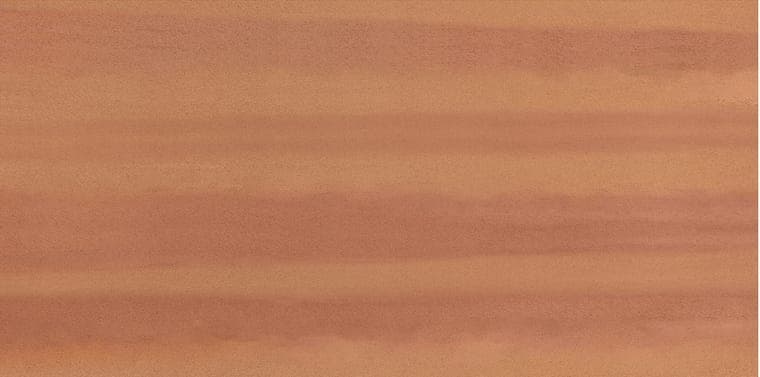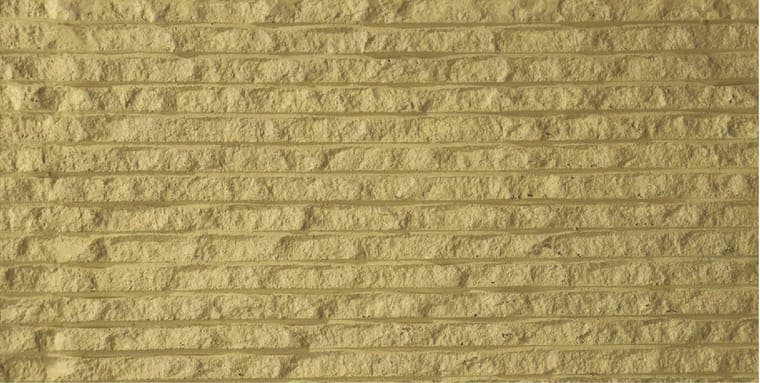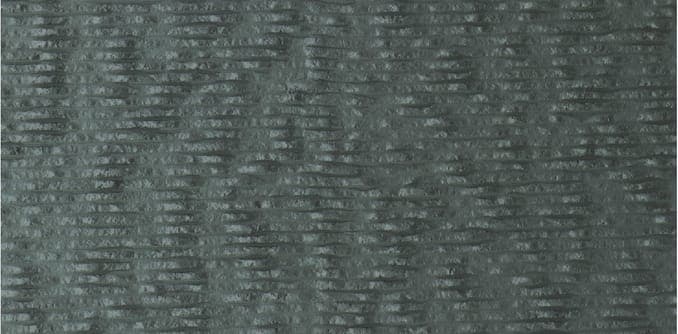
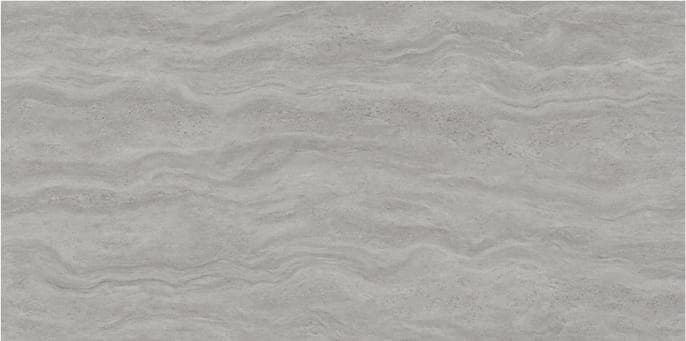
Travertine
6 shadesBanded Roman stone, six metres a man can carry
Clay wall cladding
Clay has been a facade material for four thousand years. Three modern forms of it are sold in India, they behave very differently, and picking the wrong one is an expensive mistake.
Clay earned its place on buildings by being local, durable and warm in a way that concrete and glass are not. It weathers slowly, it holds colour because the colour is mineral rather than applied, and it does not go the streaky grey that painted render goes after two monsoons.
What has changed is the form. For most of that four thousand years, clay cladding meant a solid fired unit — a brick, a tile, a block — laid wet and carrying its own weight. Every modern clay cladding product is an attempt to keep the surface and shed the mass.
Three forms
Same raw material, three very different propositions once it reaches site.
A fired clay brick sliced thin. Genuine brick colour and texture, and the most convincing of the three at close range. Heavy enough to need mechanical support above about 3m, and corners need purpose-made return pieces that have to be ordered with the job.
Best for: Low-level facades, plinths, feature walls where the brick reading is the point.
Extruded fired clay baguettes or panels hung on an aluminium subframe with an open cavity behind. Excellent thermally and the only one of the three that ventilates. Also the most expensive, and the frame alone often costs more than the cladding.
Best for: Large commercial elevations with a real facade budget and a services coordination team.
Clay modified with a polymer and cross-linked rather than fired, so it bends. Bonds directly to the substrate with no frame and no mechanical fixing, and turns any corner or radius without a special piece.
Best for: Retrofits, curved geometry, interiors, wet areas, and anywhere the structure cannot take load.
We supply the third. That is a position, not a claim that the other two are wrong — if you are building a new-build commercial elevation with a facade budget and a ventilated cavity in the design, terracotta rainscreen is a genuinely better answer than anything we sell.
The Indian case
A north-facing wall in Bengaluru spends four months damp and the rest of the year in shade. Painted render goes green. Natural stone holds up structurally but stains along the bedding planes and needs re-sealing. The property that matters here is not waterproofing on its own but fungus and algae resistance — the surface has to be inhospitable, not just impermeable.
A west elevation takes direct afternoon sun for most of the year. Any finish whose colour is a coating will shift — first a little, then visibly, and always unevenly, so the shaded strip under the chajja ends up a different shade from the wall below it. Clay cladding whose pigment is mineral and distributed through the body does not have that failure mode, because there is no surface layer to degrade.
The genuinely under-discussed one. Bengaluru facades collect a fine grey film within weeks. Deeply textured cladding holds it in the recesses and needs washing down; smoother finishes shed it. If the elevation is somewhere nobody will ever get a hose to, a flatter collection like Granular Stone is a more honest choice than a deep-relief one, however good the deep one looks in a sample.
Most Indian cladding work is refurbishment, not new build — and the structure was designed for render, not for a stone rainscreen. Checking and strengthening an existing frame to carry 55 kg/m² is often what kills a stone scheme at cost stage. This is where a 4.5 kg/m² bonded sheet stops being a compromise and becomes the only option that gets built. The full comparison against stone and ceramic sets the numbers out row by row.
Clay finishes
Every one of these is the same 3mm mineral body — the difference is the mould and the pigment.
FAQ
MCM stands for Modified Clay Material. It is a cladding made from coloured inorganic mineral powder — clay-based — blended with a high-performance water-based polymer modifier, then cross-linked and shaped by microwave irradiation. The result is a thin, lightweight sheet that carries the texture and colour of fired clay or natural stone but bends cold around a curve.
Yes. It is waterproof, UV stable so a south or west elevation holds its colour, and fungus and algae resistant, which matters on a north wall through the monsoon. It is also freeze-thaw resistant, so it is suitable for hill-station projects.
As an indicative supply rate, ₹350–₹450 per sq ft, supply only, ex-Bengaluru. Where a project lands in that band depends on the collection, the pattern variant and the quantity. The figure worth comparing is the installed cost, not the material rate: there is no support frame, no structural allowance, no wet cutting and far less labour, which typically brings the total below a natural stone equivalent even where the material rate is similar. Send us your area and collection and we will come back with a written quote.
A traditional clay or stone veneer is a thin slice of rigid material — typically 5–20mm — that still has to be cut to shape, mitred at corners and mechanically supported on tall walls. Flexible clay is a bonded sheet at 3mm that bends around a corner instead of being cut to fit it, weighs a fraction as much, and needs no support frame.
Maintenance is washing down with water. There is no sealing cycle, no annual oiling and no re-grouting, because the colour is mineral pigment through the body rather than a surface coating, and there are no grout lines to discolour.
No. Colour comes from inorganic mineral pigment distributed through the body rather than from a printed or coated surface, so a west-facing elevation holds its shade rather than bleaching out over a few summers.
Get a quote
Tell us the elevation, the substrate and whether it is exposed or sheltered. We will come back with the collections that suit it and a written price.
Send us the area, the substrate and the finish you have in mind. We reply with shade options, a written price and a lead time — usually the same working day.
The enquiry form loads in a moment. If it does not, email us at enquiry@curvato.in and we will pick it up from there.
Get a quote
Tell us the area, the substrate and the finish you have in mind. We reply with shade options, a written price and a lead time — usually the same working day.