
MCM · Modified Clay Material
Modified Clay Material (MCM): what it actually is
MCM is clay that has been chemically modified so it bends instead of shattering. Here is what goes into it, how it is made, and what that changes on a building.
MCM stands for Modified Clay Material. The name is doing real work: this is clay, and it has been modified. Both halves matter, because the first is what gives the finished sheet the colour and the surface of fired earth, and the second is what stops it behaving like a tile.
What it is made from
The base is coloured inorganic mineral powder — clay-based, with the pigment distributed through the body rather than printed onto a face. That is why an MCM sheet cut in half shows the same colour all the way through, and why a west-facing elevation does not bleach out over three summers the way a coated panel does.
To that powder is added a high-performance water-based polymer modifier. The polymer is the modification. It forms a network through the mineral body that holds the particles in relation to one another while still allowing them to move slightly against each other under load.
How it is made
This is where MCM parts company with every ceramic product. A ceramic tile is fired: heated past the point where the clay vitrifies, fusing the particles into a rigid, glassy solid. That vitrification is what makes a tile hard, and it is also exactly what makes it brittle. A vitrified body cannot flex; it can only crack.
MCM is not fired. The mixed body is cross-linked and shaped by microwave irradiation. The microwave energy drives the polymer to cross-link — to form bonds between its own chains — throughout the mineral matrix, at a temperature far below vitrification. The result is a solid, stable sheet whose internal structure is elastic rather than glassy.
Bend an MCM sheet and the mineral particles shift a little against each other while the cross-linked polymer network takes the strain and returns them. Release it and it springs back. That single process difference is the whole product.
What it changes on a building
Three things follow from it, and they are the reasons MCM gets specified at all.
Curves stop being expensive. Cladding a circular column in stone means either bespoke curved sections cut on a CNC or a faceted approximation with a mitre every 150mm. An MCM sheet wraps the column. See how curved cladding is actually set out for the practical detail.
Weight stops being a structural question. At roughly 4.5 kg per square metre against 55–65 kg for a 25mm stone slab, an MCM elevation does not need a support frame, does not need the structure re-checked on a retrofit, and cannot shed a panel onto the pavement.
Installation stops needing a wet trade. Sheets cut with a knife and fix with a notched trowel and adhesive. No diamond blade, no water feed, no slurry — which is why the material clears mall fit-out rules that ban wet cutting outright.
What MCM is not
It is not a wallpaper, a vinyl or a printed laminate. The texture is physical relief moulded into a mineral body, not an image, which is why it survives close inspection and raking light.
It is not a structural material. It is a finish, bonded to a sound substrate, and it needs that substrate to be level and dry — see substrate preparation.
And it is not the same thing as a thin stone or traditional clay veneer, which is a slice of rigid material and still has to be cut to turn a corner.
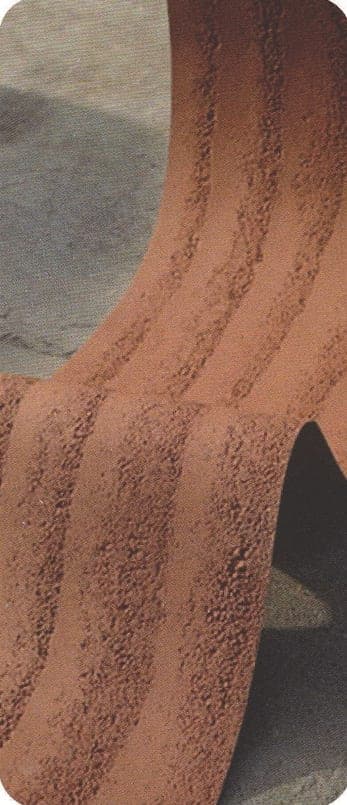
An MCM sheet under bend. The mineral body carries the colour and texture; the cross-linked polymer network lets it flex and return.
At a glance
Modified Clay Material specifications.
The figures a consultant asks for first.
| Full name | Modified Clay Material |
|---|---|
| Abbreviation | MCM |
| Also called | Soft ceramic tile, flexible clay cladding |
| Base material | Coloured inorganic mineral powderClay-based, pigmented through the body |
| Modifier | High-performance water-based polymer |
| Forming process | Cross-linked and shaped by microwave irradiationNot kiln-fired, which is why it stays flexible |
| Thickness | 2.5–3.5 mm |
| Weight | Approx. 4.5 kg/m² |
| Fire classification | Level A1 (non-combustible) |
| Minimum bend diameter | 381 mm (15 in) coldA 190 mm radius |
Sheet sizes and pack quantities vary by collection. Tell us the wall dimensions and we will advise the most efficient set-out — full sheet specifications covers the rest.
Where the term comes from
MCM, soft ceramic, flexible clay — same material.
The category picked up several names on its way into India. They describe the same product.
Modified Clay Material, abbreviated to MCM, is the manufacturer's term and the one you will see on a technical data sheet. Soft ceramic tile is a translation artefact that stuck — the material is not ceramic, because it is never fired, but it looks enough like one that the name travelled. Flexible stone cladding and bendable wall tiles are how it gets described in search, and flexible clay sheets is what we call the product when we are quoting it.
One distinction worth holding on to: some products sold as flexible stone cladding are genuine stone — a very thin slice of slate or sandstone laminated to a fibreglass backing. Those bend a little, and they are a real material with real uses, but they are heavier, more fragile at the edges and considerably more expensive per square metre. MCM is a manufactured mineral body, which is why it comes in 139 shades rather than whatever the quarry yielded this month.
For the wider category and where clay sits against the alternatives, the clay cladding overview is the better starting point. For a row-by-row comparison against natural stone and ceramic tile, see the comparison table.
FAQ
Questions we get about this
What is MCM?
MCM stands for Modified Clay Material. It is a cladding made from coloured inorganic mineral powder — clay-based — blended with a high-performance water-based polymer modifier, then cross-linked and shaped by microwave irradiation. The result is a thin, lightweight sheet that carries the texture and colour of fired clay or natural stone but bends cold around a curve.
How thick and how heavy is flexible clay cladding?
Finished thickness is 2.5–3.5mm depending on the collection, and weight is approximately 4.5 kg per square metre. For comparison, a 25mm natural stone slab weighs roughly 55–65 kg per square metre, so the same elevation carries under a tenth of the dead load.
Is it fire rated?
Yes — Level A1, the highest non-combustible classification. That is what makes it usable on high-rise elevations, escape routes and protected stair cores where combustible cladding is not permitted.
What does flexible clay cladding cost in India?
As an indicative supply rate, ₹350–₹450 per sq ft, supply only, ex-Bengaluru. Where a project lands in that band depends on the collection, the pattern variant and the quantity. The figure worth comparing is the installed cost, not the material rate: there is no support frame, no structural allowance, no wet cutting and far less labour, which typically brings the total below a natural stone equivalent even where the material rate is similar. Send us your area and collection and we will come back with a written quote.
Get a quote
Tell us about the wall.
Send us the area, the substrate and the finish you have in mind. We come back with shade options, a written price and a lead time — usually the same working day.
Request a quote
Send us the area, the substrate and the finish you have in mind. We reply with shade options, a written price and a lead time — usually the same working day.
The enquiry form loads in a moment. If it does not, email us at enquiry@curvato.in and we will pick it up from there.
Get a quote
Specifying MCM on a project?
Send us the elevation or the wall dimensions. We come back with shade options, sheet quantities and a written price.
- Thickness
- 2.5–3.5 mm
- Weight
- ~4.5 kg/m²
- Fire rating
- Level A1
- Min. bend dia.
- 381 mm (15 in)