Skip to content
Curvato

Clay veneer · Flexible clay veneer

Clay veneer, and what flexible veneer changes

Both are thin. Only one of them bends — and that single property decides how corners, columns and curves get detailed, priced and built.

What “veneer” means here

A veneer is a thin layer of a material applied over something structural, so you get the surface without the mass. In cladding it usually means one of two things: a clay veneer — a fired clay unit sliced thin, essentially a brick slip or a thin terracotta tile — or a stone veneer, a slice of quarried stone at 5–20mm, sometimes laminated to a backing board.

Flexible clay veneer is the third form. Modified Clay Material cross-linked rather than fired, so the sheet stays elastic. It is a veneer in the same sense — a thin applied surface over a structural substrate — and it behaves completely differently once it is on site.

The comparison below is the one worth having. It is not “flexible is better”; it is a list of the eight things that actually differ, including the one where traditional veneer wins.

Side by side

Traditional clay veneer vs flexible clay veneer.

  • Thickness

    Traditional veneer
    5–20 mm
    Flexible clay veneer
    2.5–3.5 mm
    Why it matters
    Matters when the cladding has to land flush inside a joinery reveal.
  • Weight

    Traditional veneer
    12–35 kg/m²
    Flexible clay veneer
    ~4.5 kg/m²
    Why it matters
    Decides whether the substrate and structure need checking at all.
  • External corners

    Traditional veneer
    Mitre both edges, or use a purpose-made return piece
    Flexible clay veneer
    Same — unless the arris is radiused to 190mm+
    Why it matters
    The one row where both need the same detail. A sharp arris is tighter than either material bends.
  • Curves

    Traditional veneer
    Bespoke curved sections, or facet it
    Flexible clay veneer
    Wraps a column down to 381mm (15in) dia.
    Why it matters
    A rigid veneer cannot follow a column at any radius.
  • Cutting

    Traditional veneer
    Wet saw, diamond blade, slurry
    Flexible clay veneer
    Knife or shears, dry
    Why it matters
    Wet cutting is banned in most mall and occupied-building fit-outs.
  • Support above 3 m

    Traditional veneer
    Mechanical fixing usually required
    Flexible clay veneer
    Bonded, no mechanical fixing
    Why it matters
    Removes the frame and the fixings from the bill entirely.
  • Colour consistency

    Traditional veneer
    Varies batch to batch with the quarry
    Flexible clay veneer
    Repeatable across orders and cities
    Why it matters
    The reason retail rollouts specify flexible.
  • Depth at close range

    Traditional veneer
    Genuine — it is real stone
    Flexible clay veneer
    Moulded relief, convincing but manufactured
    Why it matters
    The one row where traditional veneer genuinely wins.

Where each one wins

Choosing between them.

Specify traditional veneer when…

  • The wall will be inspected from arm's length by people who care that it is real stone — a heritage restoration, a stone merchant's own showroom.
  • The geometry is entirely flat and orthogonal, so the corner and curve problems never arise.
  • The specification names a particular quarry, and matching it matters more than anything else on this list.
  • The structure has capacity to spare and the programme has room for a wet trade.

Specify flexible clay veneer when…

  • There are columns, arches or curved reception fronts — anything from a 381mm (15in) diameter column upwards. This is the decisive one — see curved cladding.
  • It is a retrofit and nobody wants to re-check the structure.
  • The programme is short, or the site bans wet cutting.
  • The finish carries into a bathroom, a spa or a covered balcony and you want continuity through the door.
  • It is a rollout, and the wall in Chennai has to match the wall in Bengaluru.

Veneer-effect collections

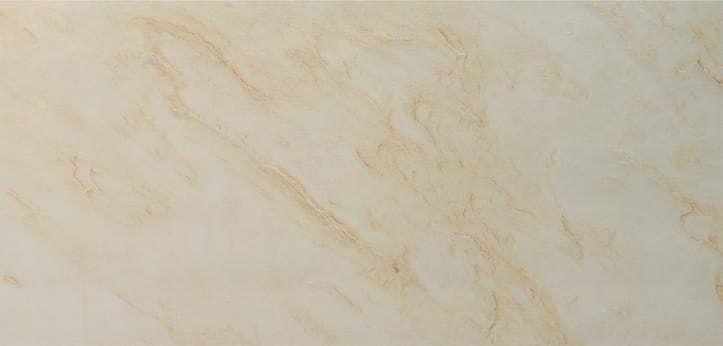
Marble, granite, onyx and split slate.

The collections most often specified where a stone veneer was the starting point.

All collections

Worth seeing in the hand before committing. Relief textures and dual-tone veining behave differently under a project's actual lighting than they do in a photograph — ask us for samples.

FAQ

Veneer questions

What is the difference between Regular and Random pattern?

Regular pattern repeats a uniform face across every sheet, so veining and coursing align tile to tile — useful for book-matched effects and for tight, controlled walls. Random pattern varies the face sheet to sheet so no repeat is visible, which is what makes a large wall read as genuinely quarried. Above roughly six square metres, Random is usually the better call.

How is it different from a clay veneer or a stone veneer?

A traditional clay or stone veneer is a thin slice of rigid material — typically 5–20mm — that still has to be cut to shape, mitred at corners and mechanically supported on tall walls. Flexible clay is a bonded sheet at 3mm that bends around a corner instead of being cut to fit it, weighs a fraction as much, and needs no support frame.

Get a quote

Tell us about the wall.

Tell us the stone you had in mind and the geometry it has to cover. We will send matching shades and an honest view on whether flexible is the right call.

Request a quote

Send us the area, the substrate and the finish you have in mind. We reply with shade options, a written price and a lead time — usually the same working day.

The enquiry form loads in a moment. If it does not, email us at enquiry@curvato.in and we will pick it up from there.

Get a quote

Send us the wall. We'll send back a quote.

Tell us the area, the substrate and the finish you have in mind. We reply with shade options, a written price and a lead time — usually the same working day.

Thickness
2.5–3.5 mm
Weight
~4.5 kg/m²
Fire rating
Level A1
Min. bend dia.
381 mm (15 in)
CallWhatsApp