
Notes
What Is MCM? A Complete Guide to Modified Clay Material
MCM explained from first principles: what Modified Clay Material is made of, how microwave cross-linking replaces firing, and where it belongs on a building.
Published · 9 min read · Curvato
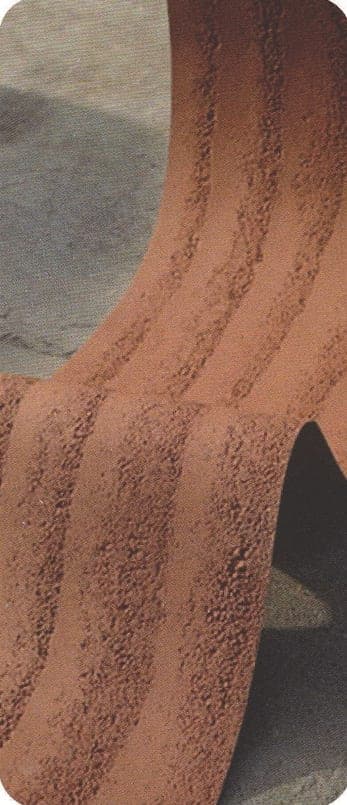
If you have been shown a sample of cladding that looks like fired clay, weighs almost nothing and bends in the hand without cracking, you have met MCM. It is one of the few genuinely new categories of architectural finish to reach India in the last decade, and it is still explained badly — usually as “flexible tile”, which is both wrong and unhelpful.
This is the long version: what MCM is made from, what the manufacturing process actually does, what follows from that on a building, and where it is the wrong choice.
What MCM stands for
MCM is Modified Clay Material. Both halves of the name are load-bearing. It is clay — which is why the finished sheet carries the colour, the mineral surface and the tactile quality of fired earth. And it has been modified — which is why it behaves nothing like a clay tile.
You will also see it sold as soft ceramic tile, flexible stone cladding or bendable wall tiles. Those are all the same category. We call the product flexible clay sheets because that describes what arrives on site.
What it is made from
The base material is coloured inorganic mineral powder, clay-based, with the pigment distributed through the body rather than printed onto a surface. That distinction matters more than it sounds. A printed finish has a colour layer that can abrade, chalk or bleach; a through-body mineral pigment has no layer to fail. Cut an MCM sheet in half and the cut edge is the same colour as the face.
To that powder is added a high-performance water-based polymer modifier. This is the modification the name refers to. The polymer forms a network running through the mineral matrix, holding the particles in relation to one another while still letting them shift slightly against each other under load.
How it is made — and why firing matters
Here is where MCM parts company with every ceramic product on the market.
A ceramic tile is fired. It is heated past the point at which the clay body vitrifies — the particles partially melt and fuse into a continuous, glassy solid. Vitrification is what makes a tile hard, impervious and dimensionally stable. It is also, unavoidably, what makes it brittle. A vitrified body has no mechanism for absorbing deformation. Apply enough bending force and it does not flex; it fails, all at once, along a crack.
MCM is never fired. The mixed body is cross-linked and shaped by microwave irradiation. The microwave energy drives the polymer to cross-link — to form bonds between its own chains — throughout the mineral matrix, at a temperature far below vitrification.
The result is a solid, stable sheet whose internal structure is elastic rather than glassy. Bend it and the mineral particles move a little against one another while the cross-linked polymer network takes the strain and pulls them back. Release it and it returns. That single process difference is the entire product.
The numbers
A finished sheet is 2.5 to 3.5mm thick and weighs approximately 4.5 kg per square metre. For comparison, a 25mm natural stone slab weighs 55 to 65 kg per square metre. It carries a Level A1 fire classification — the highest non-combustible rating — and wraps cold around any column of 381mm (15in) diameter or more, without heating, scoring or relief cuts. Note that the limit is quoted as a diameter, not a radius; in radius terms it is 190mm.
What that changes on a building
Curves stop being expensive
Cladding a circular column in stone means either bespoke curved sections cut on a CNC — accurate, beautiful, four-week lead time, priced accordingly — or faceting the circle with a mitre every 150mm, which reads as a polygon pretending to be a cylinder. A flexible sheet simply wraps the column, with one seam on the back where nobody stands. This is the single largest cost difference the material creates, and it is why curved cladding is the application where MCM has effectively no competition.
Weight stops being a structural question
Most cladding work in India is refurbishment, and the existing frame was designed for render, not for a stone rainscreen. Checking and strengthening a structure to carry 55 kg/m² is frequently what kills a stone scheme at cost stage. At a tenth of that load the question is never asked. There is also no panel heavy enough to injure anyone if a fixing fails — which is the argument that matters to a consultant on a high-rise.
Installation stops needing a wet trade
Sheets cut with a knife and fix with a notched trowel and polymer-modified adhesive. No diamond blade, no water feed, no slurry, no dust. That is what lets the material clear mall fit-out rules that ban wet cutting outright, and it is why a retail rollout can be done overnight in an occupied centre. The method is set out on the installation page.
The finish can go where clay normally cannot
Waterproof, fungus and algae resistant, freeze-thaw stable and UV stable. In practice this means a bedroom finish can carry straight through into the ensuite without a change of material at the door, and a north-facing Bengaluru wall does not go green through the monsoon.
Where MCM is the wrong answer
Three cases, and they are worth stating plainly.
When the value is provenance. If the point of the wall is that it is genuinely quarried Carrara, no manufactured mineral body substitutes for it however convincing the face. Specify a real stone veneer.
When the substrate is poor and staying poor. A bonded 3mm sheet follows the wall underneath it. Undulation, hollow render and lippage all telegraph through, and deep-relief collections show them worst. A rainscreen on a frame can span over a bad substrate. This cannot.
When you need a ventilated cavity. If the facade build-up depends on air moving behind the cladding, a bonded finish is the wrong system entirely and a terracotta rainscreen is the right one.
What to ask for when you enquire
Four things get you a useful answer rather than a brochure: the approximate area, the substrate, whether the wall is exposed or internal, and any curves with their dimensions. If there is a column involved, the diameter decides which collections wrap it cleanly.
And ask for physical samples. Relief textures and dual-tone veining behave differently under a project's actual lighting than they do in a photograph, and the difference is not subtle.